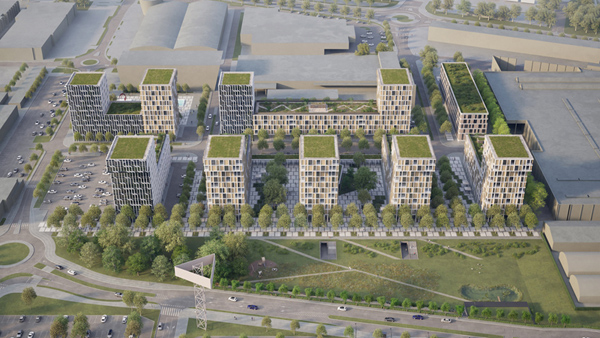
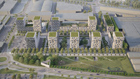
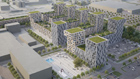
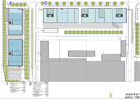
| By defining the boundary
conditions, 6 building blocks are established in accordance
with the provisions of the OPN – A, B, C, D and F. Each of
the building blocks is defined as a separate project – each
is defined programmatically and volumetrically according to
the desired role in the composition. The composition in the
OPN does not exploit the permitted capacities to the limit.
Given that the project is faced with a multitude of risks,
we estimate that every investment must be comfortable – exploiting
resources to the extreme always brings additional risks, which
can manifest themselves in increasing costs.
URBAN PATTERN:
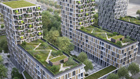
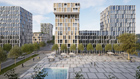
We introduce vertical dynamics into the classic Karelian urban
pattern, define the relationship to open space with accents
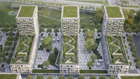
and add orientation to the ambience. Height regulation is
conservative – most buildings have a base height of P+4, on
which a composition of height accents is created. Next to
the park, the height of the accents is P+11, in the second
row the height of the accents is P+10. Smaller building islands
have predominantly linear building, which creates the primary
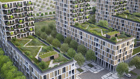
street space. The largest project (project B) has a floor
plan composition that also creates two internal environments
that act as integrators of the qualities of the central park
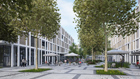
into the depth of the building towards the south. The perimeter
of the public areas is defined by covered arcades that enable
a better separation of the public and residential programs
and thus improve the living qualities of the apartments. In
one of the environments there is perhaps the possibility of
arranging a kindergarten. All buildings have a public ground
floor – they are connected to the street space, which the
programs should provide for all-day dynamics.
PROGRAM :
Project A has a planned program of rental apartments with
a higher level of care (concierge, cleaning, house help, etc.).
The building is planned to have approximately 60 apartments
in a structure of apartments that is similar to that in project
B, but the area of ??the apartments can be reduced in proportion
– this can result in up to 85 apartments in the building,
among which the richer two-room apartments predominate. Project
B has a planned residential program, on the ground floor we
are arranging support programs for the apartments - a larger
fitness center, kindergarten, library, some catering, service
(dry cleaners, dealerships, etc.). Projects C, D, F and G
have a planned business program that can most easily withstand
the boundary conditions - these projects create the most suitable
milieu for the arrangement of the largest building island
among them - Given all the circumstances, it will be most
difficult to ensure suitable conditions for a quality and
market-interesting residential program.
STREET SPACE:
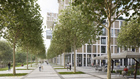
The street space is being established in a wider width, always
with a two-sided avenue, some parking on the south side of
the northern building islands is for quick errands and visits
to the arranged area. The urbanity of the arrangement should
be recognized in terms of quality references - due to the
multitude of other challenges, we propose a calm atmosphere
that a typical user of the space will be able to recognize
as their own. The selection of quality materials and details
will be of great importance. The northern urban area has no
possibility of communication with Kajuhova Street in a significant
time perspective, so traffic accessibility is established
with access from the south (Harvey Norman roundabout) and
from the east - the road towards the BTC market. The northern
urban environment is therefore not designed as a traffic area,
but as a high-quality pedestrian urban zone, which opens to
the north onto Central Park. This urban park quality is drawn
into the depths of the building blocks towards the south with
intermediate environments between the buildings. Traffic arrangements
stop at the southern edge of the northern building blocks,
and entrances to the underground floors are also arranged
here. |